
Precalculus in Tucson
1. Introduction
Precalculus in context (optional reading).
Precalculus, as its name suggests is largely to prepare students for Calculus. However, in its modern adaptation, or at least its adaptation in the Arizona Math Standards, it’s more than just that. Per the documentation provided by the Arizona Department of Education, while traditionally Precalculus courses have “served to prepare students for entrance into Calculus,” the Arizona standards have been written for students to “experience extended mathematical concepts regardless of their future pathway.”
What explains this shift in emphasis? This shift from strictly preparing students for Calculus to more broadly giving an “experience” of topics applicable to some nebulous array of potential “future pathways” (which presumably still includes Calculus)?
While I’m not aware of any official documentation accounting for the shift, it seems we can piece together a plausible picture in light of the evolving nature of the STEM field through the 20th and 21st centuries.
It’s not a novel idea that 20th century math education was grounded in Cold War era, Space-Race fueled, physics-readiness fever. The idea here is that math education was centered around producing the physicists and mechanical engineers ‘necessary’ to compete in a global posturing conflict, and that meant sending as many students as possible through the Precalculus-to-Calculus pipeline.
However, at the turn of the 21st century, with global conflicts having fallen into the background and the rise of computers, Calculus began to lose its ‘peerless’ status. Math was no longer solely about modeling a physical world that moves in continuous curves – vehicle motion, rocket trajectories, pricing trends – but started to become more and more about dealing with discrete phenomena and binary states; (e.g., with computers, but also with advances into the subatomic realm).
Hence, in the modern day, a well-rounded approach to a student’s math education, not only prepares them to apply math in the “continuous” sciences with Calculus (e.g., engineering), but to the “discrete” sciences with other high-level math courses (e.g., computer science and logistics), and to fields that combine both (e.g., modern physical & biological sciences that rely on computational methods or increasingly deal with small particles, such as geology, molecular chemistry, and computational biology). Below is a graphic showing some broadly categorized fields.
While this may all sound rather complicated, per the Arizona Precalculus standards, preparing students for these realms beyond Calculus apparently only requires one addition; and that is matrices. Below is a mapping of the topics in a “modern” Precalculus course – namely, in this case, one defined by the Arizona standards.
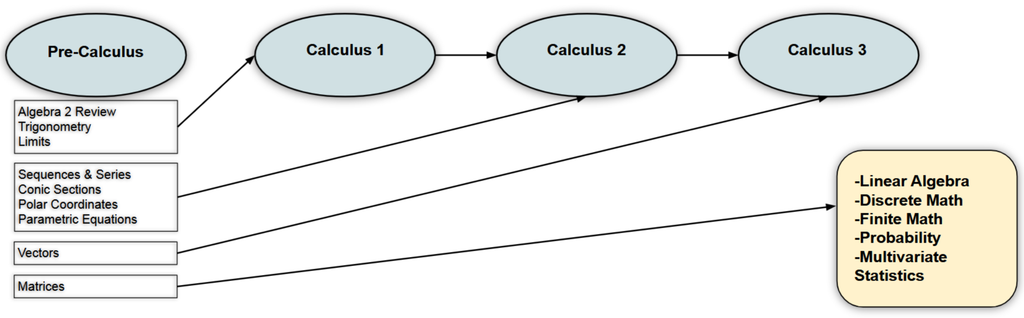
As the diagram shows, every topic in Precalculus maps to a Calculus courses except matrices. This illustrates how, generally speaking, a “traditional,” 20th-century style Precalculus course would stop at vectors, while modern Precalculus – to adapt to the evolving STEM landscape – adds them on. Matrices are the building block and universal language of the discrete sciences (e.g., as functions are the language of the continuous sciences).
And so, the idea is, equipped from Precalculus with not only the tools needed to succeed in Calculus, but also those required in fields related to sciences emerging from 21st century technological & theoretical advances, a student is prepared to continued onward into the modern landscape, academically or otherwise.
2. The Prerequisites & Progression
What are the prerequisites to Precalculus?
The prerequisite to Precalculus is, quite simply, Algebra 2; (minus any of the Statistics & Probability standards). What that leaves is essentially a list of functions and a list of things to be able to do with them. Here’s the list of functions:
- Linear
- Polynomial (primarily quadratic, cubic, quartic)
- Exponential
- Piecewise
- Logarithmic
- Rational
- Radical
- Trigonometric (limited to sine, cosine, and tangent)
And here’s a graphic showing the general list of things to be able to do with these functions.
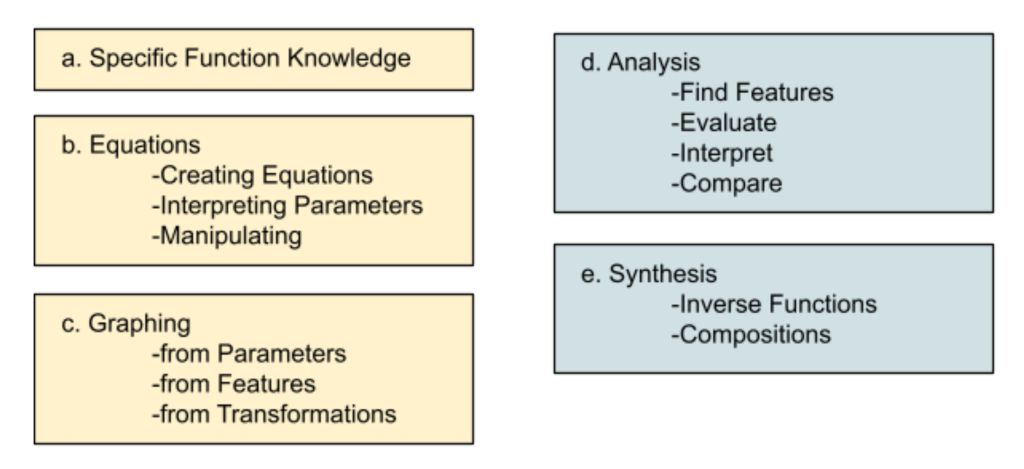
(What’s meant by ‘Specific Function Knowledge’ is essentially the understanding and algebraic ability to be able to work with that function; e.g., for logarithmic functions, understanding what a logarithm is, evaluating logarithms, and applying logarithm rules).
What is covered in Precalculus?
Unlike “Pre-Algebra,” which simply prepares a students for Algebra 1, which then, in turn, solely prepares a students for Algebra 2, “Pre-Calculus” covers some topics to prepare for Calculus 1, but then also some topics that won’t come up until Calculus 2 and 3. To illustrate, we can borrow and extend the graphic used in the ‘Introduction’ section above.
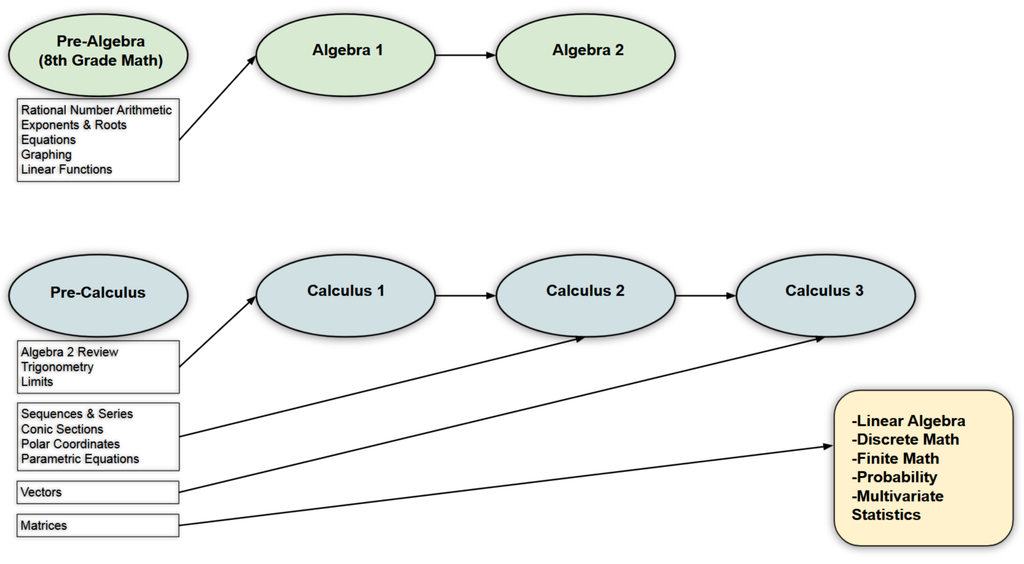
Here we can see that, for example, Algebra 2 only has one prerequisite (one arrow pointing towards it), i.e., Algebra 1. Conversely, Calculus 2 has two prerequisites – Calculus 1, and some concepts covered in Pre-Calculus that were skipped right over in Calculus 1; this is to say, the prerequisites to Calculus 2 are Calculus 1 and Pre-Calculus.
With that established, we can break down the topics covered in Precalculus by the primary course they are relevant to; i.e., a prerequisite to. (Note: some of the text included below is a direct facsimile of the Arizona standards text).
| Calculus 1 (AP Calculus AB) | |
| Functions | -Continue to identify key features, graph, sketch, and interpret parameters -Continue modeling with function arithmetic & composition -Continue to interpret quantities involving functions & their inverses -Sketch all six trigonometric functions & identify key features -Determine if a function has an inverse and restrict domain as needed -Verify whether functions are inverses |
| Limits | -Use limits to describe long-range behavior, asymptotic behavior, and points of discontinuity |
| Trigonometry | -Model with trigonometry -Solve problems using Law of Sines and Law of Cosines -Use trigonometry to find the area of triangles -Use special right triangles to find sine/cosine/tangent values for 30°, 60°, and 90° -Use the unit circle to find values for related angles -Use the unit circle to explain symmetry (odd and even) and periodicity of trigonometric functions -Use inverse functions to solve trigonometric equations in real-world context and interpret solutions -Identify ways to rewrite a trigonometric expression -Rewrite trigonometric expressions to reveal properties -Solve trigonometric equations |
| Calculus 2 | |
| Conic Sections | -Model with conic sections -Identify key features (foci, directrix, radii, axes, asymptotes, center) (graphically & algebraically) -Sketch from key features -Create equation from key features -Determine type of conic section given an equation in general form |
| Sequences & Series | -Model with sequences & series -Describe using covariational reasoning -Use sigma notation to represent finite or infinite series -Find sums of finite or infinite series |
| Polar Equations | -Graph polar equations -Analyze and interpret graphs -Use polar equations to solve problems |
| Parametric Equations | -Model with parametric equations -Use parametric equations to solve problems -Graph & identify orientation -Analyze and interpret graphs |
| Calculus 3 | |
| Vectors | -Understand vectors have magnitude and direction -Represent vectors using directed line segments using appropriate symbols -Find the components of a vector by subtracting the coordinates of an initial point from the coordinates of a terminal point -Solve problems involving velocity and other quantities -Add and subtract vectors -Multiply a vector by a scalar |
| Other Courses | |
| Matrices | -Use matrices to represent and manipulate data -Add, subtract, and multiply matrices of appropriate dimensions -Multiply matrices by scalars to produce new matrices -Use matrix operations to solve problems -Find the inverse and determinant of a matrix -Use matrices to solve systems of linear equations |
5. Additional Supports for Alternative Tracks (Homeschool, Learning Pods, & Micro-schools)
Show details.
The following additional services are offered for those in ESA learning contexts. (ESA-Approved Vendor – $0 out-of-pocket with ClassWallet).
Option A: Course Consulting + Validation Report ($1260 per semester)
This support option is best for those wanting to self-teach or utilize established online platforms, but want to add an extra layer of individualization, structure, and quality control (i.e., for ensuring well-rounded, solidified understanding and alignment to state standards e.g., for ACT/SAT and college admissions).
- Initial Diagnostics: 60-minute personalized assessment to identify math knowledge and skill deficits relevant to current course progression.
- Progress Evaluations: Five, hour-long blocks spaced throughout the semester to review completed course materials, analyze any written work, and assess for proficiency (e.g., for early identification of difficulties that could compound).
- Midterm & Final Exams: In-person proctoring of Arizona standards-based midterm and final exams.
- Signed Validation Report: Issuance of a course completion report, upon meeting appropriate criteria, displaying state-certified Educator Identification Number (EIN) to lend an extra layer of legitimacy for state audits and college admissions.
Option B: Full-Course Instruction ($2400 per semester)
This support option is best for those wanting to delegate math course instruction fully. This option entails individually tailored Precalculus instruction from an Arizona teacher-certified instructor formally rated “Highly Effective Teacher”. (Learn more about Matt here).
- Full-Course Instruction Includes:
- Live Instruction: 2x per week (60 minutes each block) (in-person or virtual, see in-person service area in table below);
- Assignments & Videos: Daily assignments with companion how-to videos;
- Assessment: Weekly exams & progress reports for quantified growth;
- Course-Completion Report: Proctored midterm and final exams & signed course completion report.
- Additional Information
- Self-Contained: No outside materials or subscriptions needed – all necessary materials provided;
- AZ Standards Based: Course is built upon the Arizona math standards, and as such, prepares students for the math portions of the ACT & SAT, and is in alignment with the Arizona Board of Regent’s (ABOR) college admissions policies;
Math Tutoring Information
| Pricing | $65 per 60-minute session |
| Format | In-person and virtual tutoring are available |
| Scheduling | Contacting via text, call, or email is the best way to check current availability |
| Service Area (In-Person) | Catalina Foothills, Midtown Tucson, Northwest, Northeast (& Tanque Verde) |
| Contact | Email: matt@azmathematics.com Phone & Text: (520) 433-2811 Location: Tucson, AZ (Note: Inquiries received Monday-Friday are typically answered within 24 hours) |