Identifying the Most Important Topics in K-12 Math
The purpose of this article is to give shape to the 350+ math standards that define K-12 math in Arizona. What is the point? What are they driving at? Is there any common thread that holds them all together?
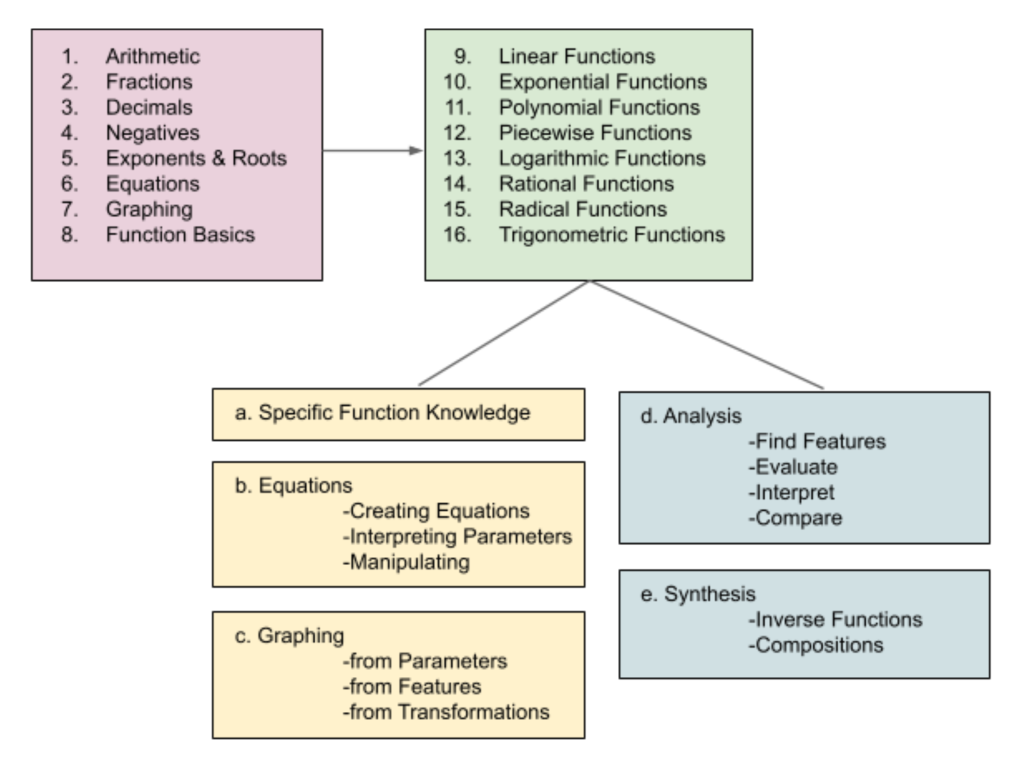
The position advanced in this article is that out of all the manifold noise, sixteen core topics can be distilled. Below are the topics (click here to see the full topics diagram):
- Arithmetic
- Fractions
- Decimals
- Negatives
- Exponents & Roots
- Equations
- Graphing
- Function Basics
- Linear Functions
- Exponential Functions
- Polynomial Functions
- Piecewise Functions
- Logarithmic Functions
- Rational Functions
- Radical Functions
- Trigonometric Functions
Contents
Introduction
A hypothetical ‘common thread’ that runs through K-12 math can be difficult to identify – chiefly due to the spiraling manner in which math courses are organized. For example, in 5th Grade Math, instruction jumps around from algebraic thinking, to place value, to fractions, to measurement, to data representations, to geometry. I would say, especially from a student perspective – but I think to parents and educators alike – there is not necessarily an obvious thread between these, other than the fact they are conventionally thought of as ‘math topics’.
This tendency to jump around between apparently disparate topics (within a single course) carries right through arguably the entirety of K-12 math. And so the main question remains – is there a ‘big picture’ here, and can we identify it? What is the nucleus which draws in these scattered topics, and forms them into a cohesive, self-justifying whole?
To begin looking into this question, we can start from the ‘source’: The Arizona Department of Education (ADE).
The ‘Big Picture’ of K-12 Math
What is the goal of K-12 math?
As outlined on the Arizona Department of Education’s website, the goal of K-12 math is to prepare students “to succeed in credit-bearing, college-entry courses and/or in the workplace.”
Put differently, the goal is to prepare students to apply math in real life, or to prepare students for more advanced coursework, which, in turn, prepares them to apply more advanced math in real life. This is to say that math education, by and large, comes down to an eventual interest in applying math to the real world; i.e., gaining the ability to “model” real world phenomena.
Astronomers want to be able to create equations to make predictions about celestial bodies, engineers want to create equations to understand how materials will behave in their products, and scientists want to create equations to model how animal populations will change alongside environmental changes.
What is a ‘function’?
The tool we have to model these phenomena, with reproducibility & predictability, is the mathematical “function”. As with the examples above, a function can be represented by an equation – but also a graph, table, or verbal description.
The precise definition of a function itself – technically being some entity which exists behind those representations – can be difficult to pin down due to centuries of evolution and adaptations of the term into various subfields of math (computer science, set theory, etc.), but for our purposes we can be content to call it a “system” or “machine” of sorts; one specifically that routes input values to singular and specific output values. That is to say, if we send in an input of “7” into this machine, the machine applies some rule to it (e.g., double it, then add 5), then sends out a single number (in that example, 19).
What is the importance of functions?
The fact that a function returns a single output for a given input is the crucial factor. For a civil engineer designing a bridge, they do not want an equation that can give two distinct “outputs” for a given input. For instance, if they create an equation to model the strength of the steel cables (output) at given temperatures (input), their model would be near useless if they plug in 120F and receive two outputs of 2,000 MPa (normal strength) and 150 MPa (on the verge of collapse); i.e., “which one is it” – is it going to collapse at 120F or be completely fine? The takeaway is that functions are specifically designed to avoid this multiple output problem and therefor have actual utility in determining (or approximating) cause and effect in the real world.
All of this, thus far, has been to say that K-12 math is ultimately about preparing students to model real world phenomena, and that to model real world phenomena we turn to the tool called a “function”.
And so this concept – the function – will form the basis for what we consider ‘the most important topics’ in K-12 math; the functions themselves, as well as the necessary prerequisite knowledge.
How and when are functions taught?
In Arizona, functions are first introduced in 8th Grade, and then more substantially covered in Algebra 1 (generally 9th grade) and Algebra 2 (generally 11th grade). With these three courses, students will have gained experience working with multiple types of functions includes: linear, exponential, polynomial, piecewise, logarithmic, rational, radical, and trigonometric.
Geometry, generally taken in 10th grade is somewhat of a tangent, not including anything noteworthy on functions (besides three standards introducing trigonometry), and 12th grade has no explicitly mandated math class per the Arizona State Board of Education (who simply prescribes a “fourth credit that includes significant mathematics”). As such, we can consider Algebra 2 as a capstone – the final word on what the ‘prototypical’ K-12 student should know; i.e., the basic math foundation for every student to have upon exiting high school- ‘entering the world’ or continuing on to a postsecondary education.
What are the prerequisites?
The prerequisite knowledge to working with functions isn’t explicitly labeled as such in the documents provided by the Arizona Department of Education. What they provide is the math standards, categorized by “domain”. Below is a chart made to show the 13 different domains and the number of standards in each domain by grade-level (the top chart is for grades K-8 and the bottom is for high school).
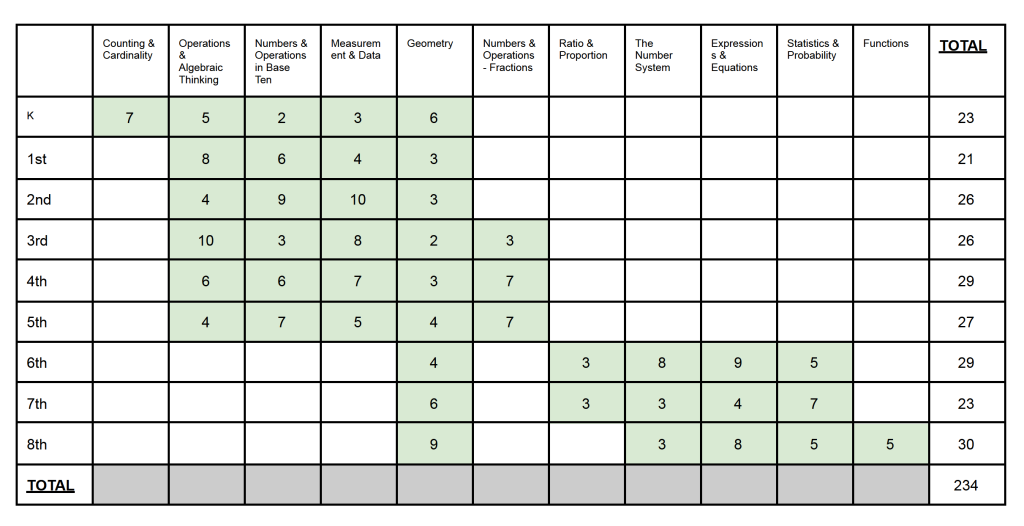
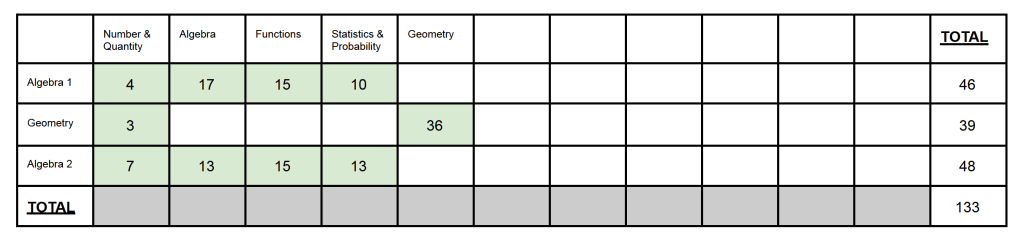
As the graphic shows, different domains are focused on in different grades. We can also see, for example, that, as mentioned, the first time ‘Functions’ show up is 8th Grade, where there are 5 function standards. As an example, here’s one of those five:
“8.F.A.1: Understand that a function is a rule that assigns to each input exactly one output. The graph of a function is the set of ordered pairs consisting of an input and the corresponding output. (Function notation is not required in Grade 8.)“
In any case, if we examine the chart further, we’ll notice there’s no domain called ‘Prerequisites to Functions’, so we’ll have to contemplate and aggregate them for ourselves.
To do that we might consider something that was briefly mentioned earlier – namely, that functions have four main modes of representation: equations, graphs, tables, and verbal descriptions. The ability to work with functions we can say is two-fold – (1) to understand the basics of what a function is, and (2) to be able to work with the different representations of functions (verbal descriptions, tables, equations, and graphs).
For our purposes, verbal descriptions & tables require relatively little specialized math knowledge, and so our focus will be on equations & graphs.
This makes it so that the prerequisites for working with functions are: (1) function basics, (2) equations, and (3) graphs.
The List of Topics
Prerequisites to Functions
While it may seem we already just listed the prerequisites above, they need to be unpacked a bit more, so we’ll do that here. At this point we’ll depart more or less entirely from the “domain” categorization of topics, and instead opt for our own method of categorization that perhaps is more intuitive for the average person, and professional alike.
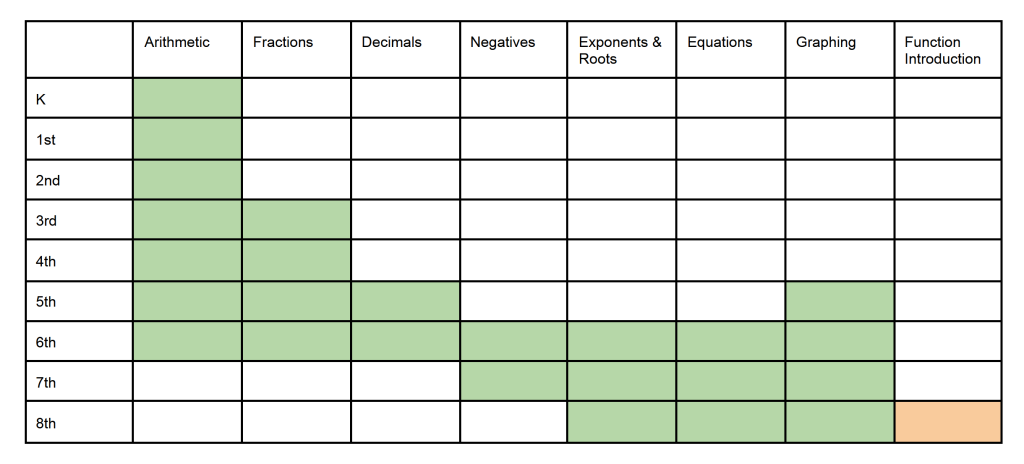
This chart may look similar to the ones above, but the columns, i.e. ‘topics,’ are labeled differently. This chart shows which grades contain standards in each topic. For example, we can see that the first ‘Arithmetic’ standards arise in Kindergarten and are concluded by 6th Grade (where students have gained fluency in the final aspect of basic arithmetic – division). Using this table we can finalize our list of prerequisites:
- Arithmetic
- Fractions
- Decimals
- Negatives
- Exponents & Roots
- Equations
- Graphing
- Function Basics
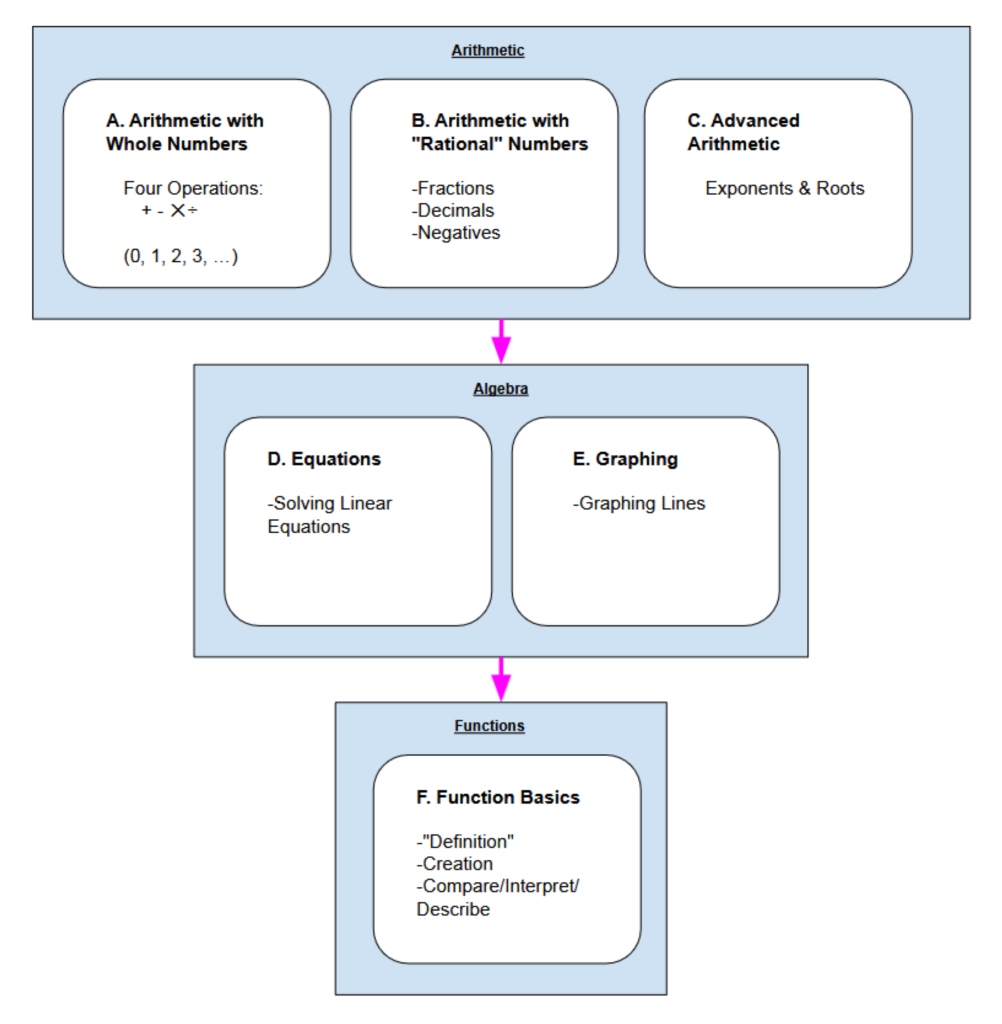
While equations, graphing, and function basics were already mentioned (earlier) as the primary prerequisites to working with functions, as the list above suggests, there is an even ‘further back’ foundation required; namely, what could be called arithmetic with rational numbers (i.e., numbers 1-5 on the list above).
With that said, the graphic below further articulates, or gives form to, the whole 8-point progression of topics, suggesting that this movement can be understood as a movement from Arithmetic → Algebra → Functions.
Functions
Once the knowledge base to work with functions is taken care of, all that’s left is the functions themselves. (These are the same functions mentioned earlier as those covered in Algebra 1 and Algebra 2).
- Linear
- Exponential
- Polynomial
- Piecewise
- Logarithmic
- Rational
- Radical
- Trigonometric
While there is some nuance within the standards as to what students should be able to do within each individual function category, we can draw up a general checklist of things to be able to do with the average function.
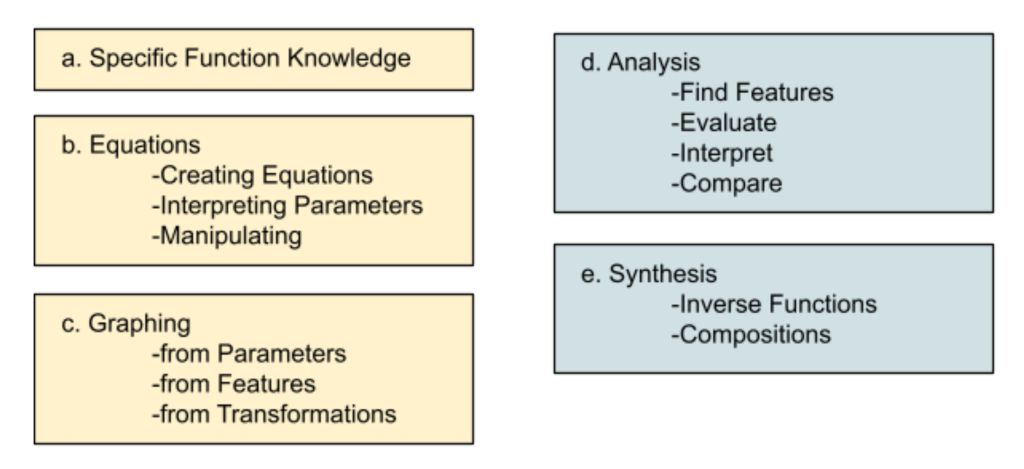
First is knowledge specific to the type of function. For example, knowing various methods of factoring quadratics for polynomial functions, knowing how to working with logarithms for logarithmic functions, and knowing the basics of sine, cosine, tangent, etc. for trigonometric functions.
Equations and graphing are somewhat self-explanatory: modeling real-life scenarios with equations, and graphing functions given different types of information and techniques.
Finally, there is analysis and synthesis. The analysis category was, by and large, the product of an attempt to parse through all of the – at times – seemingly “desultory,” function-related standards and gather together all of the verbs in them (interpret, compare, etc.) to understand the big picture of what is going on. (To be sure, this so-called apparent ‘lack of a clear plan’ in the standards easily may be a product of my own short-sightedness as opposed to any less-than-ideal decision on the part of the authors). The word analysis is used to connote ‘breaking down’ and scrutinizing functions, and synthesis is used to mean operating on functions to ‘generate’ new functions.
Conclusion
By now we’ve established that functions can be thought of as the precise ‘throughline’ for K-12 math that we sought from the start.
We considered the stated goal of the very entity who establishes & sets forth the Arizona K-12 Math Standards in the first place – the ADE (and technically the Arizona State Board of Education) – and understood it, in so many words, as preparation of students to apply math to the real world.
We advanced the function as the principal tool used in applying math to the real world and outlined the core arithmetic and algebraic progression, starting from Kindergarten, and leading up to the introduction of functions in 8th Grade, before outlining the main list of functions covered by the end of Algebra 2 and the types of things for students to be able to do with them.
It’s worth mentioning now, that while emphasis in the preceding sections was placed on arithmetic and algebra topics, ‘auxiliary’ topics within the 350+ math standards, such as geometry, measurement, and statistics, readily affix themselves to the same ‘nucleus’ of the function. (In modeling real world phenomena, numbers are often measurements, and functions can be based upon geometric structures or matters of statistics & probability).
Condensed K-12 Topics Map
Below is a graphic to serve as the ‘single takeaway’ from this entire account. It shows the eight prerequisite topics, the eight function topics, and the ‘sub-skills’ for each function type.