
Algebra 2 in Tucson
This course essentially represents the final leg in developing the algebraic skills needed to succeed in higher level coursework including, but not limited to, Calculus. As outlined by the Arizona Department of Education, students extend into the complex number system, solve & interpret varieties of equations, expand their tool-kit of functions, and venture into conditional probability.
Contents
1. The Challenge of Algebra 2
The difficulty with this course can be said to be two-fold. The first is simply how high up it is in the ‘house of cards’; any so-called “imperfections” in the lower levels are now liable to create unavoidable shudders throughout the entire structure. The second is, perhaps unsurprisingly, dealing with high-level, conceptually demanding topics including: logarithms, trigonometric functions, complex numbers, the Unit Circle, and inverse functions.
2. Prerequisites & Course Topics
In my view, the primary goals of Algebra 2 are to gain proficiency in working with a list of about eight or so functions, and to learn more about statistics. The prerequisites to this are covered in K-8 Math (arithmetic, algebra, and introduction to functions), Algebra 1 (covering around four or so function types, and some statistics), and Geometry (trigonometry basics).
Prerequisites to Algebra 2
K-8 Math
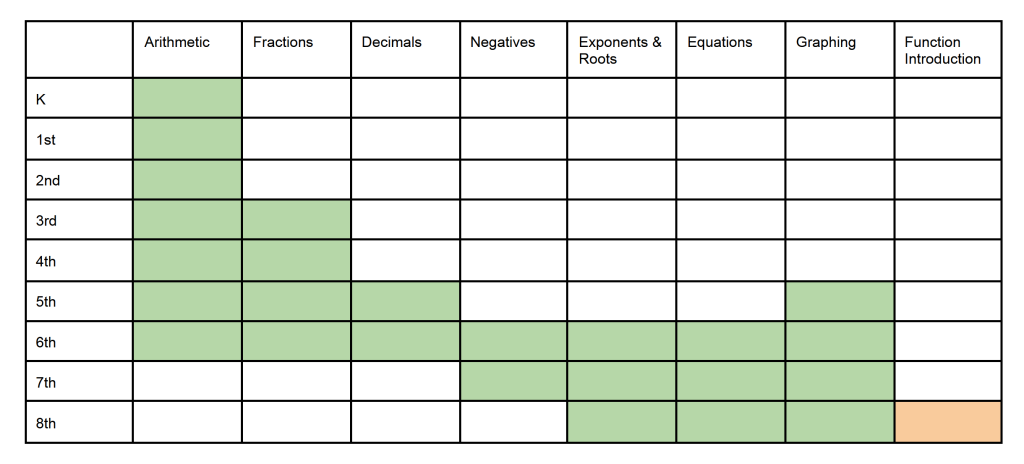
This graphic, also featured on the Algebra 1 page, shows the grade-by-grade progression of what could be considered to be the main, foundational topics of K-8 math. These topics compose the base of the arithmetic & algebraic “tool-kit” that will carry students through Algebra 1, Algebra 2, and beyond.
Geometry
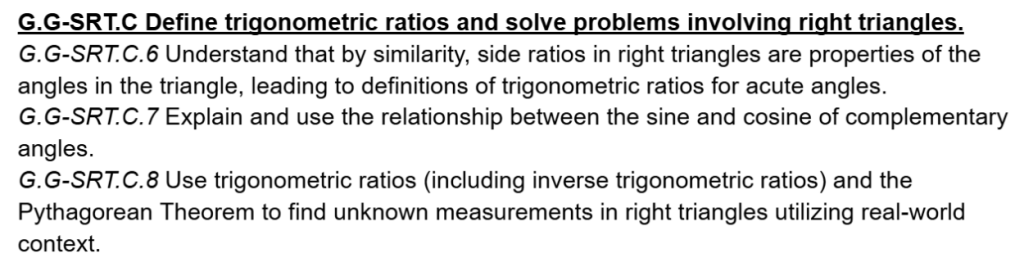
Out of the 39 standards in Geometry (i.e., the course generally taken in 10th Grade), I would say we are really only interested in these 3. These standards lay the foundation for working with trigonometric functions in Algebra 2.
Algebra 1 & Algebra 2
Rather than including Algebra 1 in the prerequisite section above, it’s included her alongside Algebra 2 in order to give the full picture of high-school algebra. The video below summarizes Algebra 2 in this context, and the table in the collapsible section just below it provides a more extensive look into the two courses.
Algebra 1 & 2 (a more comprehensive look).
There is quite a lot included in this table, but to me the this is an invaluable resource in understanding the progression of high school algebra.
| Algebra 1 | Algebra 2 | ||
|---|---|---|---|
| 1. Function Specific Knowledge | |||
| Linear |
| ||
| Exponential |
|
| |
| Quadratic |
|
| |
| Polynomial |
|
| |
| Piecewise |
|
| |
| Logarithmic |
| ||
| Rational |
| ||
| Radical |
| ||
| Trigonometric |
| ||
| 2. Modeling with Functions |
|
| |
| 3. Graphing Functions |
|
| |
| 4. Analysis of Functions | |||
| Find Features |
|
| |
| Evaluate |
| ||
| Interpret |
|
| |
| Compare |
|
| |
| 5. Synthesis of Functions |
| ||
| 6. Statistics & Probability |
|
|
3. Support Strategy
Due to the sheer volume of content – both that which has stacked up anterior to Algebra 2, and that in the course itself – providing support can require an optimized approach; i.e., one of measured and adaptable prioritization. This means, in addressing any prerequisite knowledge gaps, skillfully navigating the process of “accelerating” the student back to grade level (finding the right balance between lingering too briefly or too extensively on past topics).
Additionally, in order to meet the high level of complexity in the Algebra 2 topics themselves, I would suggest it’s of reasonable importance to both: (a) select effective explanations for concepts (no surprise there), but also to (b) have a sense of a ‘big picture’ of the course and convey it either directly or perhaps even indirectly, through a sensed cohesiveness, to aid in the construction of a mental “schema” (i.e., a cognitive blueprint of knowledge-yet-learnt to which future additions can affix themselves).
4. Additional Supports for Alternative Tracks (Homeschool, Learning Pods, & Micro-schools)
Show details.
The following additional services are offered for those in ESA learning contexts. (ESA-Approved Vendor – $0 out-of-pocket with ClassWallet).
Option A: Course Consulting + Validation Report ($1260 per semester)
This support option is best for those wanting to self-teach or utilize established online platforms, but want to add an extra layer of individualization, structure, and quality control (i.e., for ensuring well-rounded, solidified understanding and alignment to state standards e.g., for ACT/SAT and college admissions).
- Initial Diagnostics: 60-minute personalized assessment to identify math knowledge and skill deficits relevant to current course progression.
- Progress Evaluations: Five, hour-long blocks spaced throughout the semester to review completed course materials, analyze any written work, and assess for proficiency (e.g., for early identification of difficulties that could compound).
- Midterm & Final Exams: In-person proctoring of Arizona standards-based midterm and final exams.
- Signed Validation Report: Issuance of a course completion report, upon meeting appropriate criteria, displaying state-certified Educator Identification Number (EIN) to lend an extra layer of legitimacy for state audits and college admissions.
Option B: Full-Course Instruction ($2400 per semester)
This support option is best for those wanting to delegate math course instruction fully. This option entails individually tailored Algebra 2 instruction from a former Algebra 2 classroom teacher formally evaluated into the top category “Highly Effective Teacher”. (Learn more about Matt here).
- Full-Course Instruction Includes:
- Live Instruction: 2x per week (60 minutes each block) (in-person or virtual, see in-person service area in table below);
- Assignments & Videos: Daily assignments with companion how-to videos;
- Assessment: Weekly exams & progress reports for quantified growth;
- Course-Completion Report: Proctored midterm and final exams & signed course completion report.
- Additional Information
- Self-Contained: No outside materials or subscriptions needed – all necessary materials provided;
- AZ Standards Based: Course is built upon the Arizona math standards, and as such, prepares students for the math portions of the ACT & SAT, and is in alignment with the Arizona Board of Regent’s (ABOR) college admissions policies;
- Self-Paced: In the case of meeting course requirements prior to instructional year-end, funds can be applied to subsequent math course (Precalculus) without penalty.
Math Tutoring Information
| Pricing | $65 per 60-minute session |
| Format | In-person and virtual tutoring are available |
| Scheduling | Contacting via text, call, or email is the best way to check current availability |
| Service Area (In-Person) | Catalina Foothills, Midtown Tucson, Northwest, Northeast (& Tanque Verde) |
| Contact | Email: matt@azmathematics.com Phone & Text: (520) 433-2811 Location: Tucson, AZ (Note: Inquiries received Monday-Friday are typically answered within 24 hours) |