
Critical Thinking: What Could it Possibly Mean?
Word Problems and Higher-Order Thought in Math Education
What is ‘Critical Thinking’?
Do any of us know what we mean when we use the term ‘critical thinking’? Is there actually something conjured up in our minds which we then use the term ‘critical thinking’ to convey to another? Or does the term precede any particular thing in our minds; i.e., we just use the term to allude to something which we figure exists despite a near-complete lack of mental differentiation?
What is the word ‘critical’ used for in this context? What is the difference between thinking and ‘critical’ thinking? Is it simply meant to elicit an image of contrivance and straining, such that thinking is not critical unless one’s brow is furrowed? Or can one critically think with an easy smile on one’s face? Does it mean one starts with an attitude of admonishment or skepticism, or that one removes oneself from the equation, maintaining the position of a detached critic?
Etymologically, it seems ‘thinking’ in this context derives from the Old English þencan (to exercise reason), and ‘critical’ derives from the Greek root krinein (to separate, sift, decide). It is not immediately clear that combining these two concepts together creates any notable synthesis of meaning; in fact, to ‘exercise reason’ seems to be rather synonymous with to ‘separate, sift, decide’.
What We Maybe Mean by Critical Thinking
So what (if anything) do we then mean when we use the phrase? While it may indeed be we are not using the term in anything resembling a well-possessed, ‘ground-up’ manner, perhaps we may rely on Sir Francis Galton’s “wisdom of the crowd” and color in some sort of picture through our numerous – and perhaps almost intentionally vague – collective attempts to weave the term into conversation. For example:
- In politics, a ‘lack of critical thinking’ seems to be used to imply a failure to consider (and place weight on) the various downstream effects of a particular policy choice.
- In astronautics, we can perhaps imagine ‘critical thinking’ would be used to identify a necessary quality of being able to efficiently and thoroughly solve unpredictable problems as they arise
- And, broadly speaking, in education,’critical thinking’ seems to often just be defined in antithesis to ‘memorization’.
In all of this, it seems perhaps that critical thinking is meant to allude to ‘higher-order’ levels of mental activity, beyond reproduction of static information, or even basic semi-dynamic applications of an algorithmic process. From the examples above, it seems we can draw out characteristics of this higher-order thinking such as the following:
Conjuring: The ability to effectively conjure up the relevant static information – this would seem to go beyond information recall as the ‘prompt’ does not specify the information to be recalled (e.g., as in the case of ‘What is a mitochondria?’). A political proposal or space-station equipment malfunction is not a 1-to-1 request for recall but a complex matrix of relevant factors and possible outcomes. (Functions such as imagination and appraisal would seem to be required – in imagining bits of information that could be relevant, and then appraising if they are in fact relevant).
Considering: Perhaps could be defined as the ability to ‘hold’ the information conjured and run ‘simulations’ with that information. For example, politically, in considering what groups might be affected in what ways, or in the context of problem solving in considering possible problem sources, solutions, and spill-over effects.
What Does This Mean in Education?
Probably the domain in which the term ‘critical thinking’ comes up the most is education. The concomitant aspersions cast towards ‘rote’ memorization seem to imply that within academia, there is a demand for a type of cognitive activity that memory does not measure up to.
Ultimately, it seems the goal of math education is to prepare students to apply math in the real world (such as in the very fields of political policy and astronautics mentioned above). As such, it does seems reasonable to then strive for a certain quality of adaptability in a student’s math knowledge.
The question then seems to become, however, how to achieve that so-called adaptability? If we open up a century-old textbook like The Thorndike Arithmetics (written by an educational psychologist, no less) we find hundreds of pages of repetitive problems, surely evoking the ‘lower-order’ faculties of the mind – i.e., namely, rote, ready-loaded algorithm practice and problem solving through relation to other similar problems (what could perhaps be called ‘constellation’-searching).
But did math education in this era fall short of preparing students to apply math in more complex and nuanced real-life scenarios? That’s a difficult case to make considering it produced the likes of figures such as David Bohm, Jonas Salk, and Richard Feynman.
So who is right? The old class of educators and educational psychologists who seemed to place principal importance upon fact fluency and algorithmic mastery, or the modern class who champions critical thinking?
It seems difficult to argue that memory is not at least a necessary component for thinking. Further still, however, particularly with the rise of Artificial Intelligence and the training of Large Language Models (LLMs), it seems there is evidence, that thinking and reasoning can be emergent properties of static information (memory) within neural networks. Apparently it is the case, for instance, that a model’s ability to do things including managing temporary internal models of reality and chain-of-thought reasoning are products of little, if not nothing, more than static weights distilled from static information (memory).
So, then, is this the case with the human brain? In the course of our math education, do we simply attend to memorizing the static information, and the rest takes care of itself? From it emerges ‘critical thinking’? Or do we need to practice something called ‘critical thinking’?
If so, how would we do that? Have students solve problems that we haven’t taught them how to solve? What does it even mean to solve a problem one doesn’t know how to solve? Why do we bother teaching anything if it’s possible to solve a problem one doesn’t know how to solve?
It seems probably the issue is in large part that we do not really understand how the brain is solving problems. Surely scientists on the cutting edge are performing experiments and forming theories but one can’t help but think science is still a ways off from truly understanding the machine of the brain (if it is in fact reducible to a ‘machine’).
It does seem fully possible that in math education, our job is to teach the algorithms and train to automaticity with the basic facts, and let the complex, higher-order faculties of the brain (emergent or not) accept our invitations as they see fit. Whether these faculties come out of “broken symmetry” of a symphony of individually firing static-memory-based neurons or some sort of secondary, adjacent or supraordinate, faculty of the mind (e.g., an entirely separate layer of communication or coordination via oscillatory electrical waves), perhaps ought not to be our principal concern. On the other hand, perhaps these higher faculties are like a muscle that can be exercised. Yet were this true, one would figure there surely would be a more methodical approach than simply providing students problems they don’t know how to solve, or simply broadly providing “word problems” – whatever those in fact are (i.e., is “Add 5 and 6.” not a word problem?).
Approaching Math Word Problems
From this reasoning, – and to reiterate slightly – it seems we can start by saying memory is an unavoidable ingredient (why it shouldn’t be gotten ‘rote’-ly, though, I’ve yet to be convinced). The next point is that either (1) that is enough – from memory, i.e., the algorithmic mastery of the basics, emerges the property of being able to solve less-algorithmically presented problems, or (2) it may be worthwhile exercising the ‘faculty’ of solving such problems in some way (or perhaps differentiated facets of an apparent faculty).
While one may maintain perhaps that memory and automaticity form the vast majority of one’s ability to mathematically problem solve in real-world scenarios, and operate in the realm of so-called higher-order mathematical thinking, perhaps it may be worthwhile – if not just for the sake of argument – to attempt a more nuanced look into the component parts of such higher-order thinking. To do so, let’s look at the quintessential instance of ‘ciritical thinking’ in math – the “word problem”.
To start, one might advance the premise that there is in fact no such thing as a “word problem” as distinct from any other type of problem. Yes, there may be problems that don’t have words, but it may be helpful to orient ourselves such that any problem one could come across in a math course is simply a “math problem”. And in a math problem, the first order of business is to find out what one ‘needs to do’. And the challenge of doing this for a particular problem falls along a continuum.

In the first case, because just about any student has had extensive practice with this exact algorithmic layout, and knows precisely what such a layout suggests one ‘needs to do’, this feels far removed, if not completely unrelated, from anything that would conventionally be referred to as a “word problem”. Conversely, on the other end of this continuum, though the problem requires exactly the same math, what one ‘needs to do’ is much more obscured.
Another way to phrase ‘figuring out what one needs to do’ would be to ‘translate into a “symbolic representation”‘ (e.g., just numbers and operations, as with the left-most problem). These so-called symbolic representations are precisely the ‘stuffs’ of lower-level, memory-based processing; they’re the substrate of the semi-static algorithmic processes that are mechanically practiced for fluency. This is to say, once one has succeeded in translating a particular math problem into a symbolic representation, they are ‘home-free’ so to speak; it’s smooth sailing from there on out.
(In the illustration below, we can see that the only difference between the left-most and right-most problems is this hurdle of translating the more complex problem(s) into their “symbolic representations”).
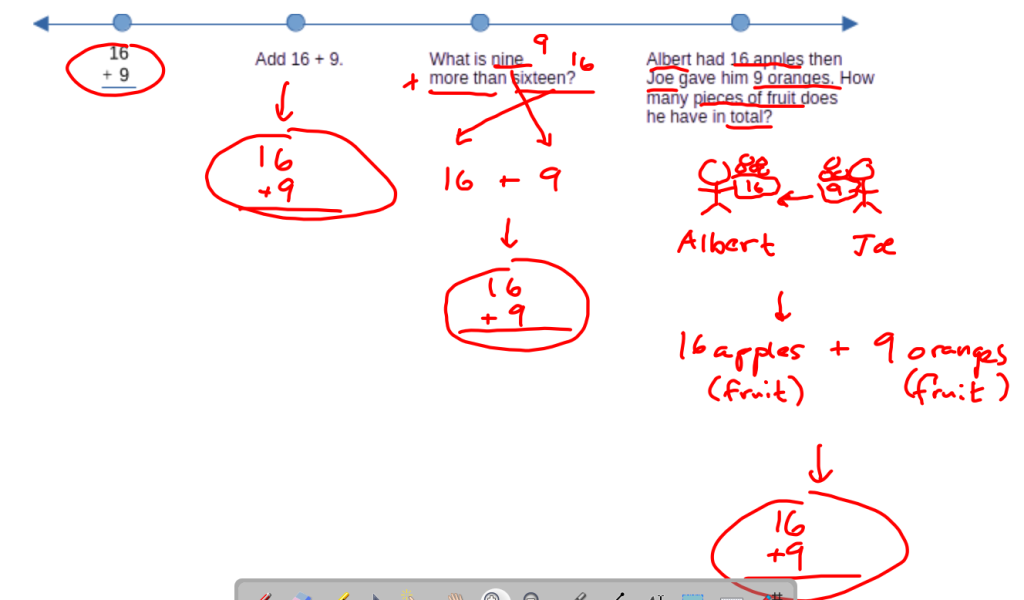
An important topic emerges here, which is that of working memory. The importance of this topic is that as we move from left to right on the continuum of obscurity, the task of translation becomes more complex, more extensive, and, as such, more demanding upon our limited cognitive bandwidth. While the process, the chain of reasoning, required for translating “Add 16+9.” likely could have been managed on a strictly internal basis (via a temporary internal model), the right-most problem presents a greater likelihood of working memory overload.
It’s like trying to carry all the groceries in one trip – at a certain number of bags it’s only sensible to make multiple trips. The analog of making multiple trips in this context is finding avenues to ‘offload’ the working memory; to relegate components of the temporary ‘internal’ model to an external model. If someone lists five multi-digit numbers and asks you to add them, this would mean, e.g., writing these numbers down on paper as an intermediary step (now the working memory is greatly relieved to not have to be juggling them internally), and with the example of a thoroughly obscured “word” problem, this generally suggests intermediary steps such as underlining potentially pertinent information, summarizing the ‘story’ via a drawing or other graphical representation (then the working memory can relax from trying to hold the full picture in place internally), or jotting down potential algorithmic approaches (i.e., as opposed to guessing and checking multiple potential paths mentally).
While we are examining this whole process of problem solving from the focal point of working memory, it could be worth further deconstructing and anatomizing the process to explore the earlier alluded-to facets of the ‘critical thinking’ process, including things like:
- (a) identifying potentially relevant information,
- (b) imagining potentially relevant symbolic processes,
- (c) appraising the value of information,
- (d) holding information in short-term memory,
- (e) fabricating appropriate internal models,
- (f) mapping patterns in problems to known symbolic processes.
This is to say, it might be worthwhile ‘further-study’ to consider if each of these facets might be cultivated with individual attention, as opposed to simply attending to freeing space within working memory and assuming they will make their appearances in the fullness of time.
Nonetheless, one will content oneself here with precisely the latter; at least on the surface, that is. It is difficult to imagine these things would be immune from the incidental exercise they would surely receive, simply in the course of practicing solving complex problems (i.e., in the absence of isolated, targeted practice).
Though perhaps one’s mind will change in the fullness of time.